
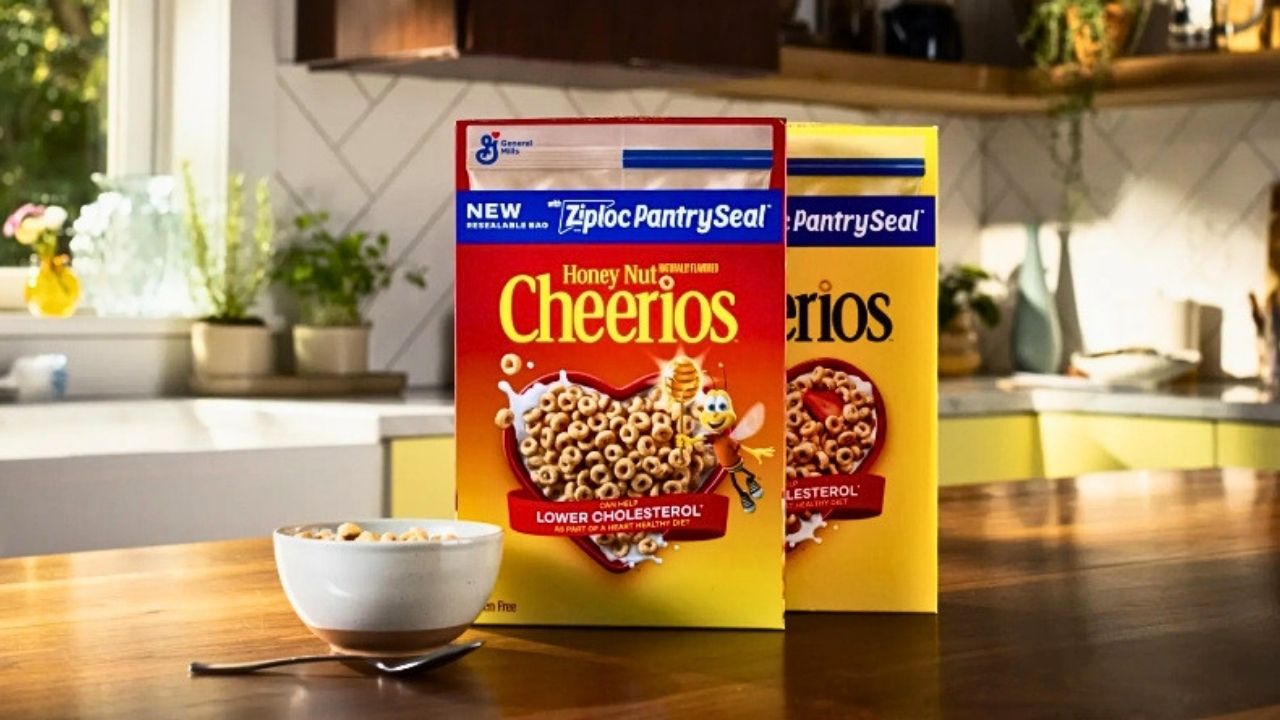
After 85 years of folding, rolling, clipping, and wrestling with cereal bags that refuse to stay closed, Cheerios has finally introduced a resealable option.
But why did one of America’s best-known cereal brands take so long to solve a problem consumers have complained about for decades?
General Mills announced on Tuesday, October 27, that it had partnered with Ziploc to introduce PantrySeal, a resealable bag inside traditional Cheerios boxes designed to make pouring easier and help preserve freshness.
The new packaging launched October 27 exclusively through Walmart.com for Original Cheerios and Honey Nut Cheerios, with a nationwide retail rollout planned in the coming months.
The bag features a partial zipper opening that doubles as a pour spout, allowing consumers to dispense cereal without opening the entire top of the package.
According to General Mills, the company receives hundreds of thousands of requests, comments, and reactions annually concerning resealable cereal packaging.
A December 2025 survey conducted by consumer research company Suzy found that 90% of cereal eaters already take additional steps to preserve freshness, including folding bags, using clips, or transferring cereal into storage containers. General Mills cited the findings in its announcement.
“General Mills has received letters, emails and DMs asking for an easier way to reseal a cereal box, and we decided it was time to partner with the ultimate freshness brand: Ziploc,” said Emilie Knox, vice president and business unit director for Cheerios at General Mills.
The development raises a question that extends beyond Cheerios: Why has an industry that sells billions of boxes annually taken so long to address one of its customers’ most common complaints?
The answer involves manufacturing challenges, packaging costs, and an industry facing declining sales, increasing competition, and persistent consumer frustration over rising prices and shrinking packages.
The technology behind resealable bags is hardly new.
Ziploc introduced zipper technology in 1968, and similar closures have become commonplace on packages containing shredded cheese, frozen vegetables, and snack foods.
However, the challenge for cereal manufacturers involves more than simply attaching a zipper to a plastic bag.
General Mills said nearly one box of Cheerios is produced every second, requiring any packaging changes to work within a massive production operation.
Resealable packaging can require modifications to manufacturing equipment, adjustments to sealing processes, and additional costs.
The concept has also been tried before.
Packaging World reported in 2004 that New Zealand cereal manufacturer Sanitarium Health Food Co. had introduced resealable zipper bags for certain cereals in 2001. The company subsequently encountered production challenges related to sealing temperatures and packaging materials.
Consequently, General Mills’ announcement is more narrowly described as the first resealable bag inside a traditional cereal box, rather than the first resealable cereal package.
The company has not disclosed the additional production costs associated with PantrySeal or whether the new packaging will carry a permanent price premium.
Launching the packaging with Cheerios gives General Mills an opportunity to introduce the change through a brand with substantial consumer recognition.
According to Nielsen sales data cited by General Mills for the 52 weeks ending September 19, 2026, Cheerios was the nation’s top-selling cereal brand by dollar sales.
Honey Nut Cheerios, introduced in 1979, surpassed Original Cheerios as the country’s best-selling individual cereal variety in 2009, according to General Mills’ historical account.
Both varieties are established products with widespread distribution and consumer familiarity.
General Mills has not specifically explained why it selected those two flavors rather than other varieties in its portfolio. However, introducing the packaging through established bestsellers offers a way to measure consumer interest without also launching an unfamiliar product.
The cereal itself has a lengthy history.
Cheerios debuted on May 1, 1941, under the name CheeriOats before adopting its current name in 1945.
It arrived decades after several other familiar breakfast cereals, including Grape-Nuts in 1897, Kellogg’s Corn Flakes in 1906, Wheaties in 1924, and Rice Krispies in 1928.
Other recognizable cereals arrived later, including Frosted Flakes in 1952, Trix in 1954, and Cap’n Crunch in 1963.
General Mills said the new PantrySeal packages are being produced exclusively in Buffalo, New York, where Cheerios was originally manufactured in 1941.
Although cereal remains a fixture in American households, the industry has experienced a substantial decline in sales volume.
According to NielsenIQ data reported by The Associated Press in July 2025, Americans purchased approximately 2.1 billion boxes of cereal during the preceding 52 weeks, compared with nearly 2.5 billion boxes during a comparable period in 2021.
That represents a decline of more than 13%.
Even at the reduced level, Americans were purchasing approximately 5.8 million boxes of cereal per day.
Changing breakfast habits, greater competition from portable foods, and concerns about processed ingredients and added sugars have contributed to the decline.
For cereal manufacturers, a packaging innovation that addresses consumer frustration could provide another reason for shoppers to reconsider a familiar product.
Cheerios has long marketed itself as a heart-healthy cereal, but the nutritional value depends considerably on the variety consumers choose.
According to the manufacturer’s nutrition label, a 1½-cup serving of Original Cheerios contains 140 calories, 4 grams of dietary fiber, 5 grams of protein, and 1 gram of added sugar.
Whole-grain oats are the primary ingredient.
Oats contain beta-glucan, a soluble fiber associated with lowering cholesterol. The U.S. Food and Drug Administration recognizes qualifying health claims linking soluble fiber from whole oats to a reduced risk of coronary heart disease when consumed as part of a diet low in saturated fat and cholesterol.
Honey Nut Cheerios presents a different nutritional picture.
According to its nutrition label, a 1-cup serving contains 140 calories, 3 grams of dietary fiber, and 12 grams of added sugar.
That represents 24% of the FDA’s daily value for added sugar, based on a 2,000-calorie diet.
Although both varieties provide whole grains and added vitamins and minerals, Original Cheerios contains substantially less added sugar.
The packaging announcement also comes with longstanding consumer complaints about cereal prices and shrinking quantities.
A 2025 U.S. Government Accountability Office report identified breakfast cereal among the grocery categories affected by “shrinkflation,” the practice of reducing package contents without a corresponding price reduction.
While the agency found that shrinkflation contributed relatively little to overall inflation between 2019 and 2024, its effects were more noticeable in certain grocery categories, including cereal.
A separate LendingTree analysis published in 2024 examined changes in prices and package sizes for grocery products sold at Walmart between 2019 or 2020 and 2024.
Researchers found that family-size Cinnamon Oat Crunch Cheerios decreased from 26 ounces to 24 ounces while its listed price increased from $3.64 to $4.93.
The result was a 50% increase in the price per ounce.
Another variety, family-size Apple Cinnamon Cheerios, decreased from 20.1 ounces to 19 ounces while its price rose from $3.64 to $4.93.
Not every cereal experienced a reduction in quantity.
The same study found that family-size Original Cheerios remained at 18 ounces, although its listed price increased from $3.53 to $4.44.
Of the 16 cereal products examined, seven had decreased in size.
Whether resealable bags become standard across the cereal aisle remains uncertain.
General Mills has not announced plans to introduce PantrySeal across its other cereal brands, including Lucky Charms, Trix, and Cinnamon Toast Crunch.
The company also has not confirmed whether the packaging will eventually replace conventional bags throughout the Cheerios lineup.
Competitors may evaluate similar packaging if shoppers respond favorably, although any expansion would depend on production costs, consumer demand, and pricing.
For now, PantrySeal remains an additional packaging option rather than a replacement for every Cheerios box.
The innovation addresses a problem that consumers have been solving themselves for generations.
After 85 years, the question may not be whether Americans wanted resealable cereal bags.
It is why they had to ask for so long.
Provided by Dallas Express


